
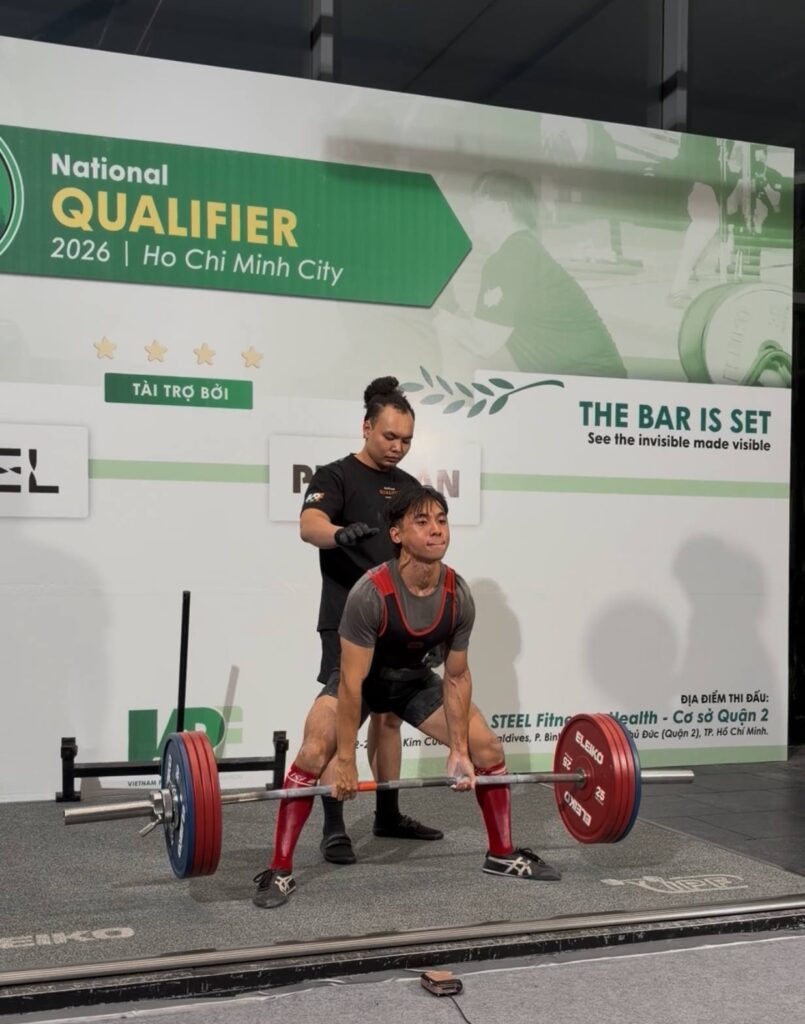
While fitness culture is rapidly expanding across Phnom Penh, powerlifting remains a largely hidden gem in Cambodia’s sporting landscape. But 24-year-old local athlete Rithy is working hard to change that narrative. After shifting his focus away from traditional Olympic weightlifting due to its steep learning curve, Rithy found his passion in the “big three” lifts: the squat, the bench press, and the deadlift. Fast forward six years, and his dedication is paying off on the international stage. Recently, Rithy proudly took home a gold medal at the 2026 National Qualifier in Ho Chi Minh City, proving that Cambodian lifters can hold their own against mature, international competitors.
Balancing gruelling three-hour training sessions with work and proper nutrition is no easy feat, but for Rithy, the discipline is entirely worth it. Driven by the people around him rather than a single idol, he views strength training not as a pursuit of vanity, but as a healthy, lifelong milestone. We sat down with the rising star to discuss his recent victory in Vietnam, his typical training routine, and his ambitious long-term goal of establishing an official powerlifting federation to put Cambodian athletes on the map.
Q&A with Rithy
1. Can you introduce yourself and tell us a little about your journey in powerlifting? I’m Rithy. I’m 24 years old and have been lifting for about seven years. I shifted specifically to powerlifting six years ago and have stuck with it ever since.
2. Why did you choose powerlifting, and what benefits can it bring? I initially struggled with Olympic weightlifting due to its steep learning curve. I figured that focusing on the “big three” (squat, bench, and deadlift) would keep me consistent with my fitness without fixating purely on vanity. Having performance milestones makes long-term training much easier and healthier to work towards.
3. What motivated you to compete at the 2026 National Qualifier in Ho Chi Minh City? Powerlifting is still a niche sport in Cambodia, which can make it hard to stay motivated to improve. After placing second at a previous competition in Bangkok, I wanted to test myself against more mature international communities. Seeking competition abroad naturally pushes me to improve.
4. How did you feel winning gold, what were your biggest challenges, and how do you prepare? Honestly, I was surprised! I experimented with big jumps on my third attempts and actually failed them, so my final total was lower than last year’s. Still, I’m happy to have another chance to improve my score this November. My biggest hurdle was balancing life, work, and nutrition with intense training sessions that can last up to three hours. Physically, I manage fatigue by tapering my training a week before the meet so I can coast in with good expectations.
5. What does a typical training day look like for you? I try to finish my daily work before hitting the gym so I can train with full intent and focus. A few hours beforehand, I’ll have some light, sugary carbs, and during heavier sessions, I stay hydrated with coconut water.
6. Who inspires you the most in your sports career? I don’t look up to one specific figure. Instead, I draw motivation from seeing the people around me putting full effort into their own goals. That drives me to do the same.
7. What advice would you give to young Cambodian athletes who want to start powerlifting? Powerlifting is a long-term sport. Don’t rush for the numbers—just enjoy the process of learning and figuring out what works best for your body.
8. What are your future goals after winning this regional competition? Right now, I am actively training for Nationals, which will also be held in Saigon. Beyond that, my ultimate goal is to establish a local federation so future Cambodian powerlifters have the opportunity to officially represent our country on the international stage.
9. What message would you like to share with your supporters and the community? I’m incredibly grateful for the support I get from my peers. I hope my journey helps people see powerlifting in a better light—heavy strength training can be done safely and makes for a fantastic, long-term fitness hobby.