
Anirudh Singh Bhati
A Cambodian ghost story by Polen Ly turns an abandoned cinema, a disappearing landscape and an unlikely friendship into a meditation on memory, rebirth and whether Cambodia can come to terms with its past.
Spoiler Warning: This article discusses important scenes from the film, including its ending.
At 7:40 on Thursday evening, I sat down at Legend Cinema in Exchange Square to watch Becoming Human, the new Cambodian film by Polen Ly. By the time it ended, the film had followed me out of the theatre.
My girlfriend and I kept talking about it that night — the ghosts, the condemned buildings, the strange water of forgetting. We kept circling back to one question: if remembering the past leaves us burdened by it, but forgetting condemns us to repeat it, how exactly are we supposed to move forward?
That question sits at the heart of Becoming Human.
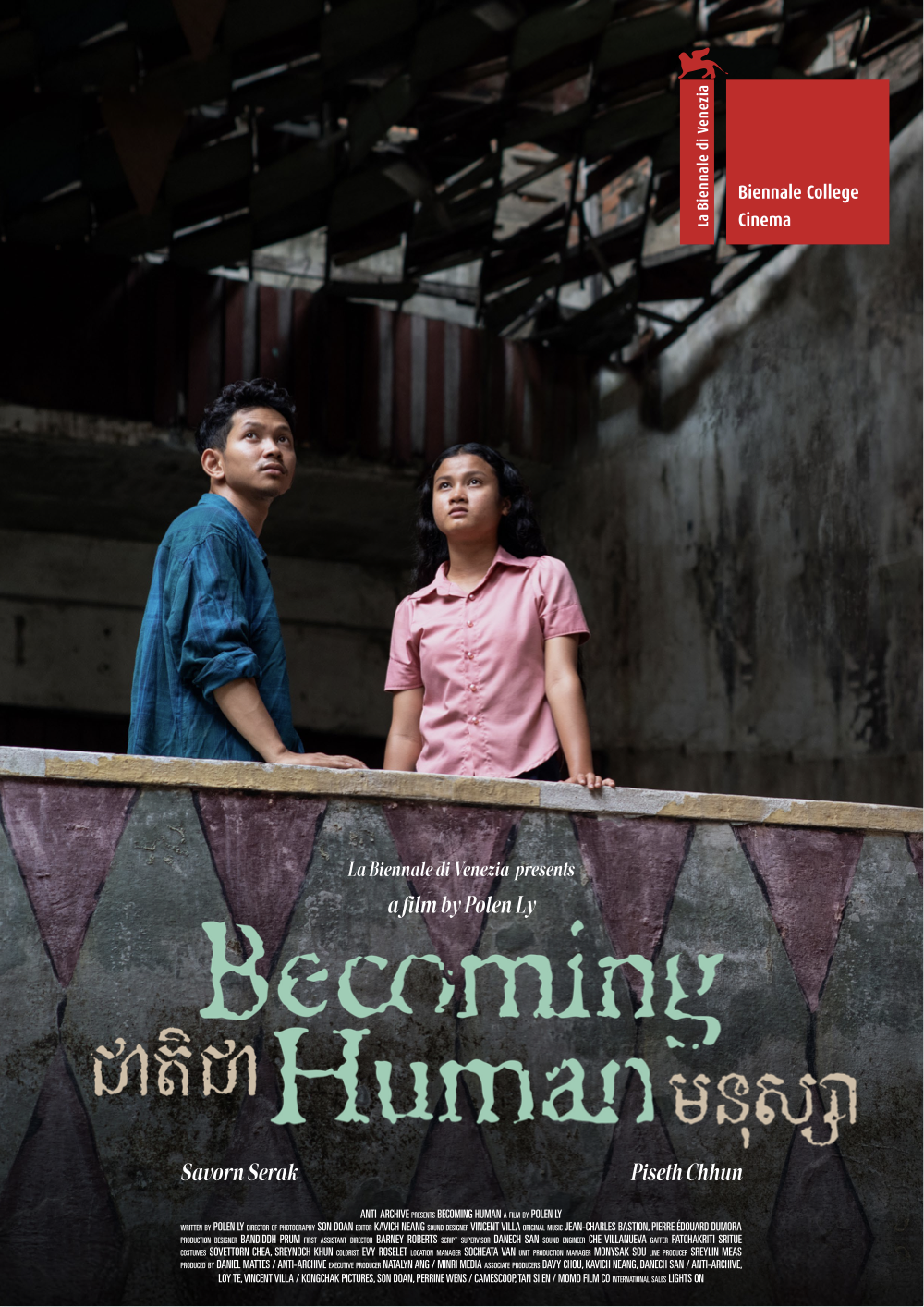
The 99-minute Khmer-language film, originally titled Chiet Chea Manusa (ជាតិជាមនុស្សា), is Polen Ly’s fiction-feature debut. Produced by Anti-Archive, it premiered at the Venice International Film Festival in 2025 and later won both the Golden Hanoman and NETPAC awards at the Jogja-NETPAC Asian Film Festival. Its two central characters are Thida, played by Savorn Serak, and Hai, played by Piseth Chhun. (Official film information)
A ghost inside a condemned cinema
Thida is the guardian spirit of an old cinema awaiting demolition. She has been there for decades, watching the building fall apart while the world outside moves on without her.
Hai is a young journalist who walks into the cinema to document it — to say goodbye, really. For reasons the film never bothers reducing to a tidy supernatural rule, he can see Thida when nobody else can.
What develops between them is a friendship built on conversation, not spectacle. In one of the film’s funnier moments, people nearby keep seeing Hai come back to the cinema and apparently talk to himself. They start wondering if he’s on drugs. They can’t see the young woman standing right in front of him.
But maybe Hai sees Thida precisely because he’s a journalist.
He’s a scribe — someone whose whole job is to notice, record and preserve what might otherwise vanish. He doesn’t just investigate the past. He befriends it.
If Thida represents the cinema, she also stands for something larger: a past that’s still present even after society has stopped acknowledging it. Hai recognises that past. He talks to it, listens to it, keeps it company.
And of course, the person who insists on talking to history is going to look a little unhinged to people who’ve decided its ghosts aren’t there anymore.
When development becomes erasure
The threatened cinema is only the first disappearance.
Around Hai’s home near a pagoda, quarrying is eating away at a hill. Dust fills the area. People are leaving. The industrial activity isn’t presented as some abstract sign of economic growth — we see what it means at ground level: a landscape being torn open, homes becoming unliveable, communities being pushed out.
The film doesn’t deliver a speech about environmental regulation or human rights. It lets the dust, the noise and the displacement make the argument for themselves.
Polen Ly has said that he created the film’s fantasy world to explore circumstances he’s witnessed around him — the loss of homes, voices, dreams and natural landscapes through unjust forms of development and change. In his account, destruction and rebuilding risk becoming their own vicious cycle. (Director’s statement)
The quarry and the condemned cinema work at the level of story and allegory, but the questions they raise are hard to miss: Who actually bears the cost of progress? What happens when development barrels forward without adequate care for the people, the communities and the landscapes in its path? And who gets to decide which places have outlived their usefulness?
For Thida, a building isn’t just a structure. A place can hold identity, memory, belonging. Destroy the place, and its spirit may become homeless too.
Searching for a home that has disappeared
At one point, Hai carries Thida’s spirit house behind his motorbike as they ride out towards the village where she once lived.
She remembers fragments — a stone bridge, the route home. But she can’t find the house itself. The world she can see no longer matches the one preserved in her memory.
Eventually she finds the plot of land where she was born and grew up. The house is gone. But a Chankiri tree still stands where it always stood — the one thing that hasn’t been torn down or built over. She recognises the place by the tree. She sits on the ground in silence and touches the earth with her hand.
It’s one of the most quietly devastating images I’ve seen in a Cambodian film.
The tree is the only monument to her past. Everything else — the house, the family, the life — has disappeared. But this one living thing has kept standing, and it’s enough to tell her she’s arrived.
The moment complicates the idea that a person should just “let go” of the past. How do you let go of a home that’s already been taken from you? How do you mourn a place after almost every physical trace of it has vanished?
The tree remembers for her. And Thida’s memory — confirmed by the tree — becomes the final surviving evidence that the home existed at all.
A song opens the door to war
Earlier, inside the old theatre, Hai plays music for Thida on his phone. He’s laughing, enjoying himself, while she listens.
Then an old song starts — what I remember as a Sinn Sisamouth recording — and Thida’s expression changes. She walks away. A piece of music that brings Hai pleasure has opened something painful in her.
He asks what happened. Eventually he reaches the question she doesn’t want to answer: How did she die?
Only later does Thida explain. She died during the war after stepping on a landmine. Her death was so sudden that, for several moments, even her spirit didn’t realise she was already dead.
The scene does something that stays with you. A song can survive the entire world in which it was first heard. Decades later, it can still carry joy, youth, grief and terror inside it — all at once.
Hai hears an old song. Thida hears her former life.
That difference is central to their relationship. Hai belongs to a younger generation trying to make sense of a history he didn’t experience in the same way. Thida carries that history as lived memory. Their friendship allows the past and the present to sit together without either pretending to fully understand the other.
The water of forgetting
Thida has resisted rebirth because she doesn’t want to risk another life of suffering. Eventually, she’s summoned to join the other spirits waiting to be born again.
She leaves without saying goodbye to Hai. But while waiting for rebirth, she runs away and comes back to find him near the damaged hill.
Hai had thought she was gone forever.
Faced with the quarry, the dust and his uncertain future, Thida breaks down. She can’t save the cinema. She can’t restore her childhood home. She can’t protect Hai’s hill. Even as a ghost, she says, she’s powerless to help him.
Hai refuses that. She’s his friend, he tells her — the one person he can actually talk to. Her worth doesn’t depend on her ability to stop the destruction around them.
That moment, I think, is where the film tells you what it really means by “becoming human.” Being human isn’t necessarily about rescuing someone. Sometimes it’s about witnessing them, listening to them, refusing to let them disappear.
Thida eventually goes back to the spirits awaiting rebirth. Before boarding a boat, each spirit is given a small amount of special water to drink. The liquid will erase the memory of the life being left behind, so the next life can begin unburdened.
Thida appears to drink.
Then, as the boat pulls away, she spits the water out. A smile crosses her face.
Is forgetting really freedom?
On the surface, the water offers mercy. Why should a newborn life inherit the anguish of the one before it? Why should Thida stay burdened by war, displacement and everything she’s lost?
Nietzsche once asked his readers to consider the cattle grazing in a field. They “do not know what is meant by yesterday or today,” he wrote. They “leap about, eat, rest, digest, leap about again, and so from morn till night and from day to day, fettered to the moment and its pleasure or displeasure, and thus neither melancholy nor bored.” A human being watches them and cannot help envying their happiness — a life neither bored nor painful, which is precisely what he wants, yet cannot have, because he refuses to be like an animal. For the human, every moment “returns as a ghost and disturbs the peace of a later moment.” (Untimely Meditations)
That is exactly what the water of forgetting promises: the mercy of the grazing animal. No ghosts, no chain to the past, every moment dying cleanly into the next.
But there’s a paradox. If forgetting frees us from pain, it may also strip away whatever could prevent that pain from happening again.
The film draws on Cambodia’s lived spiritual world, where Theravada Buddhism coexists with older traditions involving guardian spirits, ancestors and spiritually potent places. It shouldn’t be mistaken for a literal lesson in Buddhist doctrine.
That said, Theravada thought makes the ending even more interesting. Within Theravada teachings, the cycle of rebirth is sustained by ignorance and craving. Liberation comes through insight into the causes of suffering — not simply through losing your autobiographical memories. Buddhist texts even associate the recollection of previous lives with profound knowledge. Forgetfulness, by itself, is not enlightenment. (SuttaCentral’s guide to Theravada teachings)
This suggests two different cycles at work in the film.
There’s the spiritual cycle of birth, death and rebirth. But there’s also a social one: destruction followed by rebuilding, followed by further destruction. Buildings disappear. Hills get excavated. Communities are displaced. Cultural memory is cleared away, and the whole process starts again under another name.
Remembering won’t free Thida from the spiritual cycle — Theravada thought is clear that liberation requires deeper insight than that. But it might interrupt the social one. If people remember what was lost and how it was lost, they are harder to lead through the same erasure a second time.
Carrying the past without being ruled by it
Thida’s final choice is more subtle than simply refusing to move on.
She does accept rebirth. She boards the boat. She travels towards another life. What she rejects is the condition that moving forward has to mean erasing everything that came before.
Her smile isn’t the smile of someone choosing eternal misery. It’s a small act of defiance. She’ll enter the future without surrendering her knowledge of the past.
Hai reaches something similar through his work. He doesn’t preserve history by placing it behind glass. He makes it a companion — something that can speak to the present, not just about it.
Memory can certainly become a prison. People and nations can get trapped inside wounds they can’t release. The Germans have a word for the work of not getting trapped — Vergangenheitsbewältigung, the struggle to come to terms with the past. Not to forgive it, not to get over it, but to integrate it into a national story that can still move forward.
Cambodia’s version of that struggle has more in common with Germany’s than either country usually acknowledges — a regime that turned on its own people, mass death, a generation that survived it and a generation that inherited the silence. But the paradox at Cambodia’s centre may be sharper. Will and Ariel Durant warned that no individual, “however brilliant or well-informed, can come in one lifetime to such a fullness of understanding as to safely judge and dismiss the customs or institutions of his society; for these are the wisdom of generations after centuries of experiment in the laboratory of history.” Nietzsche’s answer was bleaker: “Not only the wisdom of centuries — also their madness breaketh out in us. Dangerous is it to be an heir.”
Cambodians are heirs to both. They inherit the greatness and glory of Angkor and the evil and destruction the Khmer Rouge unleashed — a regime that pulled an entire country into a state of national psychosis. And here is the knot that Becoming Human keeps tightening: it was the knowledge of that glorious past, rekindled during the colonial period, that may have fed the fierce desire to recreate it — a desire that led, in the end, to something that was its opposite. How do you carry what happened without either denying it or letting it consume you?
Becoming Human asks us to notice the difference between remembering and being imprisoned by memory.
A trauma that goes unwitnessed becomes a haunting. A memory that’s heard, recorded and shared can become history — and history, given time, can become wisdom.
That’s what Thida and Hai give each other. He gives her past a witness. She gives his sense of loss a history. Neither can save the other’s home, but each keeps the other from facing its disappearance alone.
And perhaps this is why Thida can finally choose rebirth at all. She has haunted the cinema for decades — not because she wanted to, but because no one had heard her. Hai listened. He didn’t fix anything, didn’t undo a single loss, but he received her story. And in being seen by her scribe — after all those years of being ignored — the past stopped being a burden she was trapped under. It became something she could carry freely.
That is why she can spit out the water of forgetting and still smile. The water offers liberation through erasure. Hai has already given her liberation through witness. She doesn’t need the amnesia. She picks the freedom that lets her keep herself.
The past can move on once the present agrees to hold it.
I walked into Legend Cinema expecting a Cambodian ghost story. I walked out wondering whether ghosts are just the memories that remain after the places that held them have been destroyed.
Becoming Human doesn’t ask Cambodia to live forever in the past. It asks whether any real future can be built by pretending the past isn’t there.